



Keeping our eyes on the prize after 25 years
What's the Digital Divide look like in 2026? It's all about access, adoption, and use.
Bowling Green, Ky. (February 19, 2026) — Today marks 25 years since Connected Nation (CN), in its various iterations, began its work to improve broadband access, adoption, and usage. Our mantra since day one has been to improve all three aspects of the Digital Divide so Americans can get the most out of broadband technology. Still, after a quarter of a century, there is a continued need for this work.
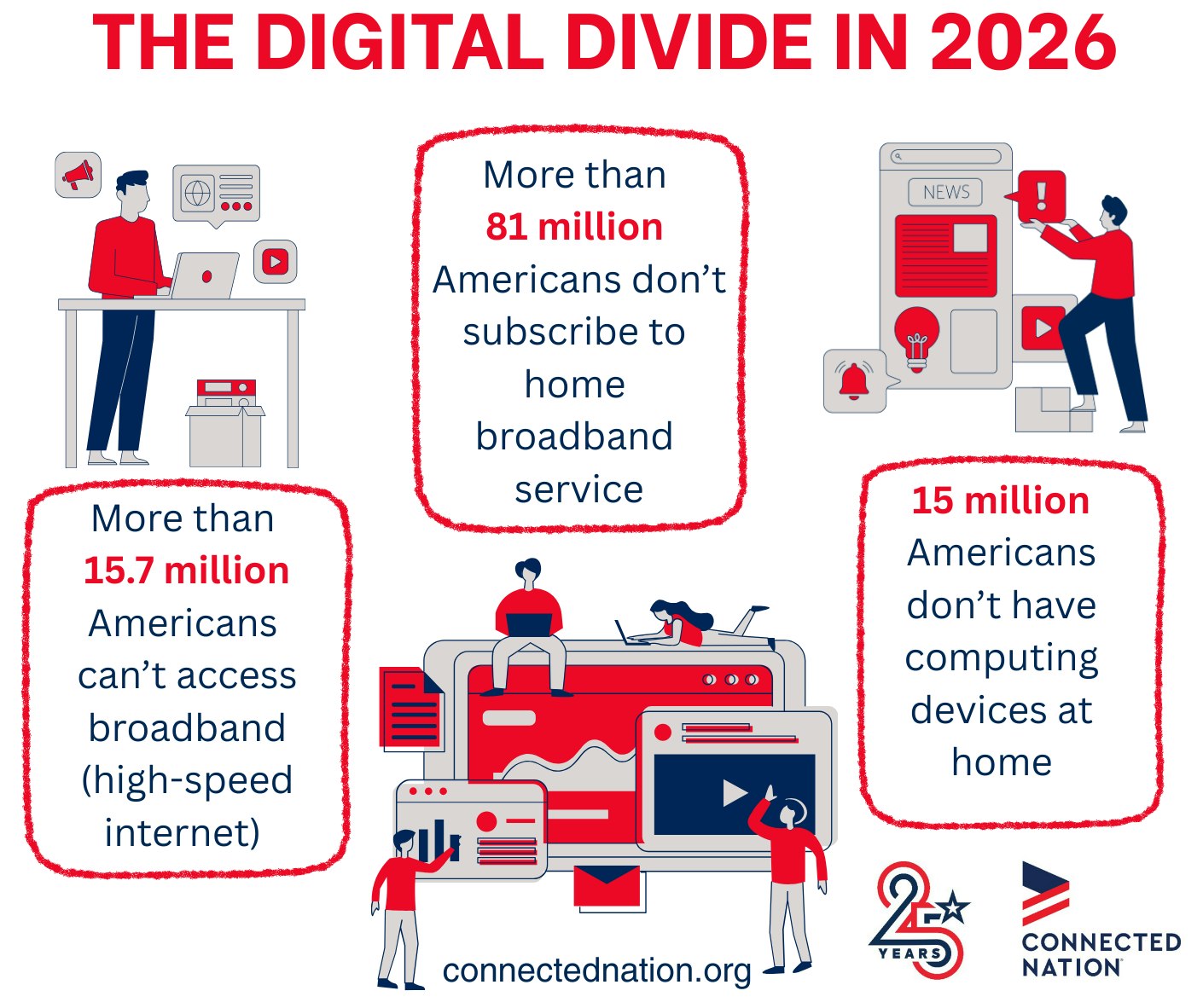
More than 15.7 million Americans can’t access broadband
The Federal Communications Commission’s most recent maps [1] show that up to 4 out of 5 housing units in U.S. states and territories don’t have access to any terrestrial internet service at broadband speeds. This represents more than 6 million households [2], home to more than 15.7 million Americans [3], who can’t access fast, reliable home internet service. Though state, federal, and local efforts have dramatically decreased this count, we don’t believe that leaving 15.7 million Americans behind is “good enough.” That’s why we’ll continue our efforts to bring this number down to zero.
More than 81 million Americans don’t subscribe to home broadband service
Making broadband accessible is only the first step, though. Even if every home in America had the necessary infrastructure, other barriers to home broadband adoption persist. We estimate that more than 81 million Americans [4] don’t have broadband service at home. For many, the cost of a monthly internet subscription represents a barrier. For others, a need for improved digital skills or a better understanding of how to stay safe online prevent people from subscribing. CN wants to make sure that everyone has the skills and access to fast, affordable broadband service that they can use to enrich their lives.
15 million Americans don’t have computing devices at home
To go online, a household must have a computing device like a laptop, tablet, or smartphone. For 15 million Americans [5], though, that’s not possible because they lack any sort of device at home. For those Americans, it doesn’t matter if a provider serves their neighborhood or if they know how to use the internet; without an internet-connected device, these people can’t go online for school, work, or entertainment.
This shows how closing the Digital Divide is a multifaceted problem. Getting online requires an available connection, the skills and desire to go online and use broadband effectively, and access to a device that can connect to the internet. All three components must be in place before someone can truly benefit from broadband service, so they all must be addressed if we want to close the Digital Divide.
Doing so is important for so many aspects of our lives. Broadband empowers people to take classes, shop, get medical help, and work in today’s world. In fact, across the United States, more than 152.6 million jobs [6] can’t be performed efficiently and effectively without essential digital skills.
For these reasons and more, we intend to keep working to close the Digital Divide. We invite you to join in our efforts to make sure every American can access and use broadband by following us on Facebook, X, or Instagram and joining us in this important mission. You can also check out our website to see how we are working to close the Digital Divide and find out what you can do to help in your community.
[1] Based on data from June 30, 2025, percent of units covered by any terrestrial residential broadband service at speeds of 100/20 Mbps in each state and territory.
[2] Based on the number of households in the United States and its territories as reported by the U,S, Census Bureau’s American Community Survey 5-year (2020-24) estimates.
[3] Based on the average household size for each state and U.S. territory as reported by the United States Census Bureau’s American Community Survey 5-year (2020-24) estimates.
[4] Based on the number of households without fixed broadband such as cable, fiber optic, or DSL at home and the average household size in each state, as reported by the U.S. Census Bureau’s American Community Survey 5-year (2020-24) estimates.
[5] Based on the number of households with no computing device at home and the average household size in each state, as reported by the United States Census Bureau’s American Community Survey 5-year (2020-2024) estimates.
[6] Based on a report from the National Skills Coalition in partnership with the Federal Reserve Bank of Atlanta, which found that 92% of analyzed jobs require digital skills and the United States Bureau of Labor Statistics which showed non-farm employment and non-farm job openings totaling 165.9 million in October 2025 (as revised on February 11, 2026).
About the author
Chris McGovern is the Director of Research Development for Connected Nation.
In this role, Chris works with Connected Nation staff and external stakeholders to develop research deliverables and provide critical analysis. He uses qualitative and quantitative techniques to interpret data, formulate reports, and make substantiated recommendations based on research findings.
